
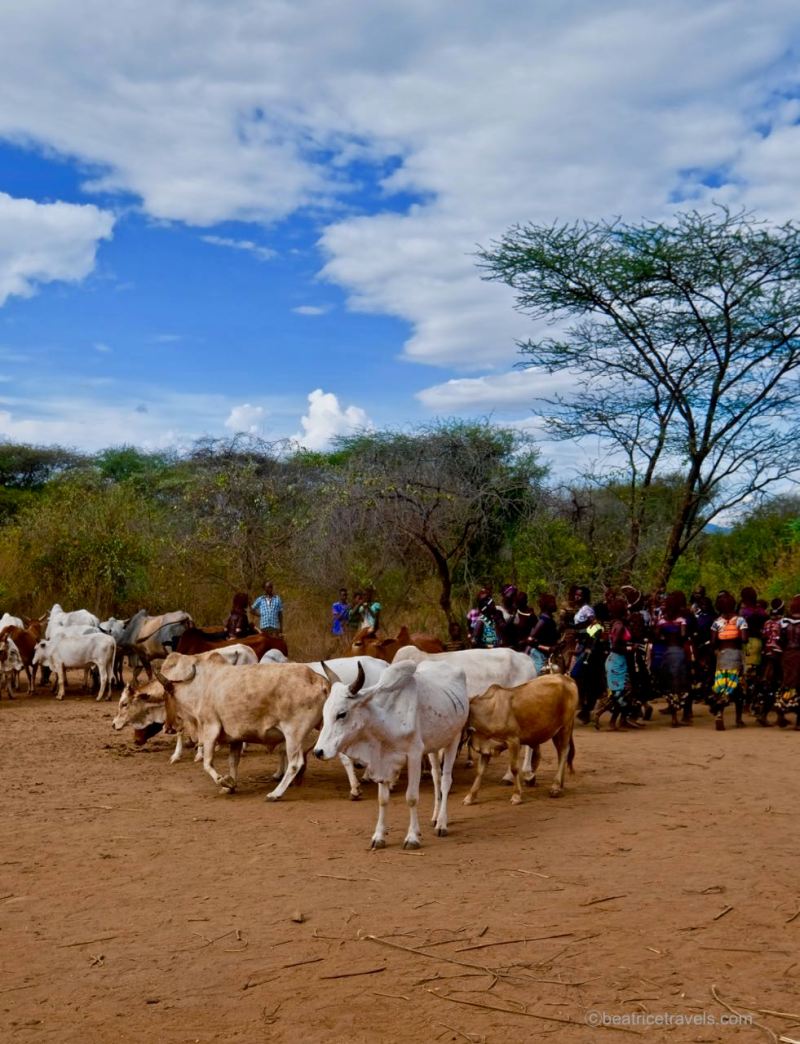
Hamar Tribe in the Omo Valley is best known for their Bull-Jumping ritual where young men have to jump over cattle as a rite of passage into adulthood and to prove their worth to the family of their intended bride. These completely naked young men must jump/run over the backs of a line of 8 to 10 bulls without falling for 4 times in a row to be considered successful. Another ritual of theirs is the women displaying scars from being whipped by the recently initiated male members of their family called Maza as a symbol of their love and support for the initiate (their brother). This whipping occurs during the Bull Jumping ceremony and the scars on their backs give them the right to demand the initiate’s help in the future. The men very often are reluctant to beat the women and the women actually beg the men to do it again and again until blood flows. These beatings occur not just during the Bull Jumping ceremony but whenever the husbands want. The women accept this because they believe this creates a blood debt. I really cannot comprehend this. Hamar women wear traditional dresses with a brown goatskin skirt adorned with vertical rows of red and yellow beads. They also wear many beaded necklaces and bracelets. Like the Himba, the Hamar women apply butterfat mixed with orange red ochre to their hair. Hamar men also have quite elaborate hair dressing where they wear clay caps that is painted and decorated with flowers, feathers, and other ornaments. Hamar men can marry as many women as they like within their own tribe. We were told that women who are not the first wife do most of the heavy labor such as carrying water, wood, etc and are actually more slaves than wives. The Hamar’s world revolves around their cattle and men spend most of their time taking care of them. Cattle is their currency and it is how they pay the bride’s father in marriage.

Hamar women chanting and dancing in circles before the bull jumping ceremony

Hamar Tribe

Hamar women proudly displaying their scars and getting hyped up for more of the pre-bull jumping whipping ritual

Hamar Tribe

Hamar Tribe

Hamar Tribe

Hamar Tribe

Hamar men all carry these little stools either to sit on or to rest their heads as pillows.

Hamar Tribe

Getting their face painted for the bull-jumping ceremony

Hamar Tribe

Hamar Tribe

After congregating in the dry riverbed, they move to another area designated as the sacred location for bull jumping. The day of bull jumping is meticulously chosen according to the stars and horoscopes. The guide told us that it never ever rains on the bull jumping day.

Hamar Tribe

Hamar Tribe

The Hamar women will bring branches to the men for whipping. One branch per whip while the women toot their horn.

The Hamar women will bring branches to the men for whipping. One branch per whip while the women toot their horn.

The Hamar women will bring branches to the men for whipping. One branch per whip while the women toot their horn.

The Hamar women will bring branches to the men for whipping. One branch per whip while the women toot their horn.

Hamar Tribe
Hamar Tribe

Hamar Tribe

Hamar Tribe

Hamar Tribe

Hamar Tribe

Hamar Tribe

Hamar Tribe

The young initiate who will be bull jumping today

The young initiate who will be bull jumping today

The young initiate on the left getting ready for his bull jump

The young initiate who will be bull jumping today

Hamar Bull-Jumping

Hamar Bull-Jumping

Hamar Bull-Jumping

Hamar Bull-Jumping

After 4 rounds of jumping, he is officially initiated into adulthood. Congratulations!

A typical Hamar village.

Hamar Village

Hamar households all have fencing surrounding their small compounds within the villages.

Hamar Village
It never ceases to amaze me how adaptable we all are. After a couple days in Omo Valley, I have adjusted to these less than ideal conditions and have become unfazed with most things. No electricity no problem, no toilet door no problem, hot as hell no problem, creepy crawlies no problem, and so on. You come to realize that you really don’t need very much. Strip away all the mannerisms and modern creature comforts, you feel like you are really just an animal. You go to sleep when tired, eat when hungry, go to the bathroom when you need to regardless of conditions. Life becomes extremely simple and basic and what you thought would scare you no longer does. Fear is really just something in your mind and when you actually are in less than favorable conditions, you are okay and can easily adapt. I love these trips where I gain a lot of perspective and learn a lot about myself. Other than the amazing photographs, what I gained and came away with is truly invaluable. As one of my close friend always said, you should always push yourself a bit out of your comfort zone in order to grow. I am eternally grateful for this experience and the opportunity.
Next post will be on two of the main markets in the Omo Valley: Key Afer and Dimeka. Stayed tuned!
Thanks for stopping by!
Click the “Follow” button to signup for email subscription or keep checking back for more blog posts to come.
Alternatively, get connected through
my Facebook page: www.facebook.com/beatricetravelsblog or follow me on Instagram @beatricetravels.
Discover more from Beatrice Wong Photography
Subscribe to get the latest posts sent to your email.


